|
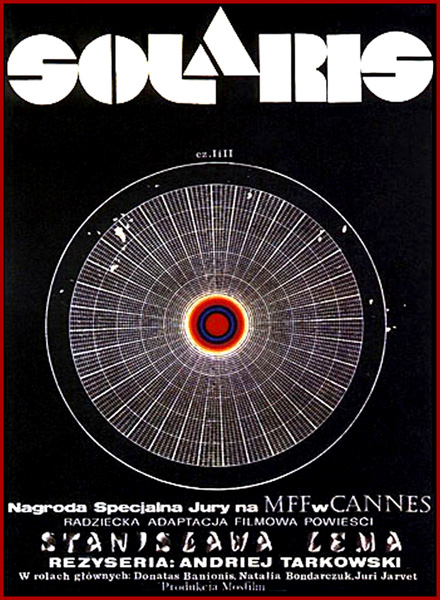
SOLARIS (1972).
 Tired of renting a film from your local video store's science fiction bin, only to discover yet another chunk of mindless American pabulum? Well, take a turn into the foreign film section next time and try out the Russian-made SOLARIS, a rare example of Thinking Man's/Woman's Science Fiction from the labyrinthine genius of the late Andrei Tarkovsky. Though not as hypnotic and maddening as his later STALKER (imagine 2001 as rewritten by Samuel Beckett), both films capture a texture for nature and complexity of themes which are rarely attempted in modern-day celluloid sci-fi. Based on Stanislaw Lem's celebrated novel, the story involves a psychologist named Kelvin who's assigned to check on some funny business at a space station circling Solaris -- a mysterious planet comprised of a swirling ocean of fog and matter. He arrives to discover the living quarters are nasty, grimy and unkept; the pair of remaining residents are half-nuts and unusually secretive; and the corridors echo with foreboding (not to mention dirty laundry). All the characters remain solemn and passive throughout (typical for Russian cinema), even as absurd, unexplainable occurrences transpire, Tired of renting a film from your local video store's science fiction bin, only to discover yet another chunk of mindless American pabulum? Well, take a turn into the foreign film section next time and try out the Russian-made SOLARIS, a rare example of Thinking Man's/Woman's Science Fiction from the labyrinthine genius of the late Andrei Tarkovsky. Though not as hypnotic and maddening as his later STALKER (imagine 2001 as rewritten by Samuel Beckett), both films capture a texture for nature and complexity of themes which are rarely attempted in modern-day celluloid sci-fi. Based on Stanislaw Lem's celebrated novel, the story involves a psychologist named Kelvin who's assigned to check on some funny business at a space station circling Solaris -- a mysterious planet comprised of a swirling ocean of fog and matter. He arrives to discover the living quarters are nasty, grimy and unkept; the pair of remaining residents are half-nuts and unusually secretive; and the corridors echo with foreboding (not to mention dirty laundry). All the characters remain solemn and passive throughout (typical for Russian cinema), even as absurd, unexplainable occurrences transpire,  such as some mysterious new additions to the ship's population. Soon Kelvin himself is pulled into the station's spell, and he must contend with the sudden appearance of his deceased wife, while trying to unravel who -- or what -- is causing these "guests" to form from the crew's subconscious desires. This a dense tale, as visionary as it is enigmatic, and though the special effects aren't going to give I.L.M. any worries, they're effective in a highly stylized way. But what makes it truly different is that instead of relying on cold technology and gimmicks, Tarkovsky builds his foundation on the all-too-human conditions of Loss and Longing. Who hasn't dreamt of reliving the past? Or seeing the person we once loved, one final time? Heavy themes to be found in a sci-fi flick, and though Tarkovsky is never subtle in his intentions, the entire enterprise is forged in personal pain... Be prepared to slow down your rhythms a bit though. Several long, pretentious sequences may tax your patience (such as a tour along an urban highway, symbolizing Kelvin's journey through space), but there's beauty to be found in every shot. And at nearly three hours long, this epic-length tale is certain to infuriate short-attention-span viewers, even as it dazzles those with an eye toward the more intellectually courageous. Though not for all tastes, SOLARIS is an uncompromising masterpiece of despair and romance, poured within the trappings of traditional science fiction. such as some mysterious new additions to the ship's population. Soon Kelvin himself is pulled into the station's spell, and he must contend with the sudden appearance of his deceased wife, while trying to unravel who -- or what -- is causing these "guests" to form from the crew's subconscious desires. This a dense tale, as visionary as it is enigmatic, and though the special effects aren't going to give I.L.M. any worries, they're effective in a highly stylized way. But what makes it truly different is that instead of relying on cold technology and gimmicks, Tarkovsky builds his foundation on the all-too-human conditions of Loss and Longing. Who hasn't dreamt of reliving the past? Or seeing the person we once loved, one final time? Heavy themes to be found in a sci-fi flick, and though Tarkovsky is never subtle in his intentions, the entire enterprise is forged in personal pain... Be prepared to slow down your rhythms a bit though. Several long, pretentious sequences may tax your patience (such as a tour along an urban highway, symbolizing Kelvin's journey through space), but there's beauty to be found in every shot. And at nearly three hours long, this epic-length tale is certain to infuriate short-attention-span viewers, even as it dazzles those with an eye toward the more intellectually courageous. Though not for all tastes, SOLARIS is an uncompromising masterpiece of despair and romance, poured within the trappings of traditional science fiction.
© 1990 by Steven Puchalski.

|